3 min read


It’s 5 a.m. and there’s frost on the ground. A farmer discovers a broken gate and must fix it before the cattle get out. On another day, a field fabricator works to repair a trailer hitch under the 100-degree midday sun, aiming to get their rig back in action. In these moments, operators count on their engine-driven welder to start and perform flawlessly.
For many, these machines are essential tools in remote locations where electric power (or electricity) isn’t available. But on these jobsites, extreme temperatures are the enemy of reliable engine performance. Inconsistent starts and engine RPMs lead to frustration, downtime and poor weld quality. These challenges, however, can be overcome by selecting equipment with an engine specifically engineered to conquer harsh conditions — ensuring that you can lay a perfect bead anytime, in any weather.
The Cold Start Challenge: A Dependable Spark on the Frostiest Mornings
For a welder operator, engine stability is critical. An engine that provides a strong, dependable start can maintain the consistent, stable RPMs required for a quality weld. But cold weather makes engines work harder. In cold temperatures, oil becomes thicker and harder to circulate, and the engine requires a different fuel-to-air mixture to start.
To combat these issues, preparing the engine with the proper oil is an important first step; using a thinner engine oil in cold temperatures is recommended. In carbureted engines, this fuel-to-air mixture can be attained by adjusting the choke for starting.
The choke provides direct command over the fuel mixture, allowing the operator to temporarily “richen” it by adding more fuel relative to air. This ensures a smooth, dependable start and delivers the stable power needed for maintaining a steady welding arc.
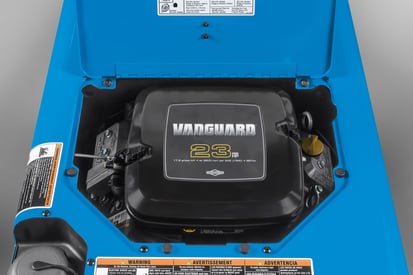
The Vanguard® 23.0 Gross HP* Small Block V-Twin engine is engineered with these exact challenges in mind. This compact, rugged engine is the power behind leading engine-driven welders like the Miller® Bobcat™ 230 and 265 models and is engineered with specific features to conquer the cold:
- Magnetron® Electronic Ignition: Provides a powerful, maintenance-free spark to ensure quick, consistent engine turnover every time.
- Operator-Adjusted Choke: An easy-to-use manual choke that gives operators direct command over the fuel mixture, allowing them to temporarily “richen” it (adding more fuel relative to air) for a smooth, dependable start.
Beating the Heat: Maintaining Full Power When the Job Heats Up
On the other end of the temperature spectrum, extreme heat can cause serious performance issues for engine-driven welders. The two primary threats are vapor lock, which occurs when fuel boils in the fuel lines or carburetor and causes a shutdown, and an improper fuel mixture.
For a welder operator, this can mean a critical loss of power and inconsistent RPMs, especially in the middle of a long bead. This power sag can lead to an uneven weld, compromising the quality of your work and forcing you to stop and restart.
In hot weather, an engine performs best when it runs “leaner,” meaning it uses a mixture with less fuel and more oxygen. Proper hot-weather maintenance also includes using a thinner engine oil and adding a fuel stabilizer to prevent moisture buildup in the fuel system.
Vanguard builds on these best practices by engineering engines with specific features designed to combat extreme heat. These features include:
- Oil Cooler: Standard on Vanguard V-Twin engines, this feature keeps oil at an optimal temperature for better lubrication and performance.
- Idle-Down System: The engine seamlessly throttles down between welds to reduce heat buildup and conserve fuel, then instantly ramps up to full power the moment you strike an arc.
Beyond temperature extremes, overall durability is key for equipment that lives outside. Total system durability goes beyond the engine block. Vanguard designs all components, including weather-protected wiring harnesses and electronics, to hold up to being stored and operated outdoors in harsh environments.
Proven in the Lab and in the Field
Trust isn't just claimed; it's earned through testing. To ensure that an engine can handle continuous, heavy-duty operation, Vanguard uses environmental chambers to simulate extreme temperatures in a lab setting, combined with extensive real-world testing in the toughest applications. As a result, operators can be assured that a welder powered by a Vanguard engine has been proven to perform reliably every day.
The Power You Can Depend On
When repairs must get done in demanding environments, a reliable engine-driven welder is a necessity, not a luxury. Choosing the right power source comes down to confidence that your equipment will perform, from consistent starts on cold mornings to cool-running power on the hottest days of summer. Vanguard engines are engineered to conquer these challenges, delivering the lightweight power and durability operators need to minimize downtime and produce high-quality welds. Choosing an engine that has been rigorously tested means you're investing in a machine that works as hard as you do.
To learn more about the advanced features of the Vanguard 23.0 Gross HP* engine, visit our product page. If you have questions about maintaining your Vanguard-powered equipment, find your local Vanguard dealer for expert service and support: https://www.vanguardpower.com/na/en_us/support/solution-selector.html
*All power levels are stated gross HP at 3,600 RPM per SAE J1940.