BATTERY SIZING MADE SIMPLE

How to find the right battery size for your application

The Challenge: Why Battery Sizing Matters 

Modern machinery demands reliability, performance, and a low total cost of ownership.

In electric systems, the success or failure of your design often depends on how well the battery is sized.

  • A battery that’s too small will underperform and overheat.
  • A battery that’s too large wastes weight, space, and cost.

The key is understanding the relationship between power and energy — and how they work together in real-world applications.

Battery-sizing-feature-800x460
Term Unit Analogy What it tells you

Energy-logo

Energy
kWh
Fuel tank size
How long the system can run

Power-logo

Power
kW
Engine horsepower
How strong or fast the system can perform

Example:

A 10 kWh battery continuously discharging at 10 kW will last roughly one hour. Continuously discharging at 5KW - two hours run time.

But — and this is crucial — you cannot simply convert engine horsepower into kilowatts and expect to get an efficient battery setup.

That approach usually leads to oversized, inefficient systems.

The Common Mistake: Misunderstanding Power and Peaks

Many OEMs design electric systems as if they behaved like internal combustion engines — and that is where things go wrong. In an engine, the rated power (in PS or kW) represents the maximum continuous output. Exceeding it, even briefly, causes mechanical stress, heat build-up, or failure. That is why traditional engines are always sized to handle the highest expected peak load.

 
Batteries Behave Differently
 

Batteries are not mechanical devices — they are electrochemical energy stores.
Their 'power rating' only defines how quickly energy can be released safely without exceeding voltage or temperature limits.

A battery with a lower nominal power rating can still handle short bursts of higher current (power peaks).

  • These peaks are typically sustained for seconds or minutes, without damaging the cells.
  • This is possible because batteries can temporarily deliver excess power, acting much like an electrical buffer.

Modern Battery Management Systems (BMS) monitor voltage, temperature, and current in real time. They intelligently regulate these short bursts, ensuring performance and longevity are maintained.


Engine vs Battery: What are the Key Differences?

Property Combustion Engine Battery / Electric System
Power output
Continuous mechanical limit
Variable, depends on chemistry and control
Overload tolerance
Very low
Variable, depends on chemistry and control
Reaction to power peaks
Must be sized for max load
Can absorb short peaks via control system
Best sizing strategy
Design for maximum peak
Design for average load + managed peaks

Understand the Duty Cycle 

One must know that understanding the character of the load is crucial for correct battery sizing. Machines do not all consume energy in the same way.

Some operate with a continuous load, drawing a steady and relatively high level of power for long periods. For these applications, the battery must sustain consistent output without overheating or falling out of its optimal efficiency range.

Intermittent-loads-icon-yellow-80x80

Intermittent loads

On-and-off use (for example handheld tools)

Others follow an intermittent load pattern, cycling between active work and pauses. Although the average power may be moderate, the system must respond quickly whenever the load rises again. In such cases, the battery can often be smaller than expected because the true energy demand is spread across many short bursts rather than one long session.

Peak-loads-icon-yellow-80x80

Peak loads

Short bursts of high power (for example lifting or digging equipment)

There are also machines with pulsed or peaky loads, where very short spikes of high power define performance. These peaks can be several times higher than the average draw. Here the battery and power electronics must be capable of delivering quick, powerful surges without excessive voltage drop or stress.

Continuous-loads-icon-yellow-80x80

Continuous loads

Steady power draw (for example pumps or pressure washers)

The Consequence of Over-Sizing

Consequence-of-oversizing-800x460

Sizing a battery purely for its peak load leads to unnecessary cost, weight, and volume. The system becomes less efficient by not utilizing its full potential, and the excess power remains unused. The primary consequence of this is unnecessary cost, weight, and volume.

A better approach is to:

  • Design around average operating load,
  • Allow brief, controlled power peaks,
  • Use the Battery Management System and cell chemistry to absorb those spikes safely.

This results in a lighter, cheaper, and longer-lasting system — without compromising performance.

Incorporate Buffers

No two working days are the same. A well-designed system must include thoughtful buffers. One must know that real machines rarely operate under ideal, repeatable conditions. Temperatures change, operators work differently, terrain varies and accessories draw extra energy. Without an adequate runtime buffer, even a correctly calculated battery can fall short in unexpected situations, leading to user dissatisfaction and unplanned downtime. A buffer protects the machine from these uncertainties and ensures consistent performance.

To keep runtime consistent, always build in some margin:

  • Depth of Discharge (DoD): Use about 90–95 % of rated capacity, not 100 %.
  • Runtime Buffer: Add 10–20 % extra capacity for unexpected peaks or tough conditions.
  • Long-Term Degradation: Allow for gradual capacity loss over hundreds of cycles.

These buffers safeguard performance and extend service life.

Calculator-icon-yellow-left-800x360

Average Power Draw (kW)

x Required Runtime (hrs)

= Baseline energy needed (kWh)

+ 5 to 10% DoD buffer

+ 10 to 20 % Runtime Buffer

+ X% Aging Allowance

= OPTIMAL BATTERY SIZE

The Right Approach: Test, Measure, Refine

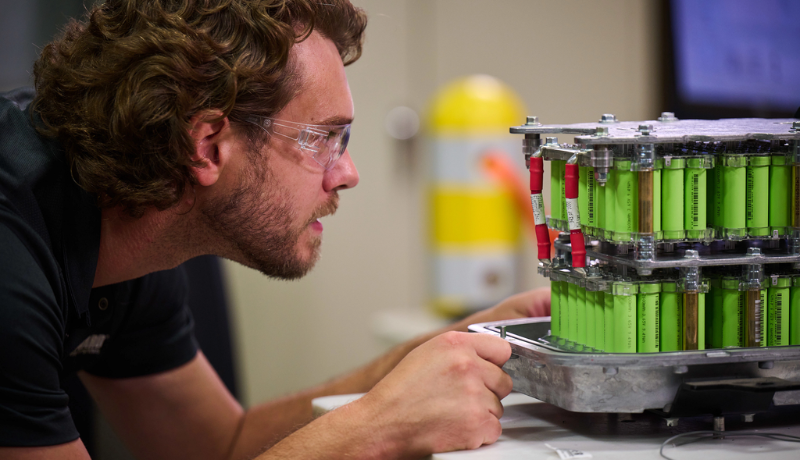
  1. Build a prototype — start slightly oversized to collect accurate data.
  2. Measure actual load profiles — including peaks, steady-state demand, and transitions.
  3. Scale intelligently — match power components to peak demand and energy components to daily usage.
  4. Validate and fine-tune — iterate until the balance of performance, cost, and endurance is optimal.
Battery-sizing-800x460

Looking for Support?

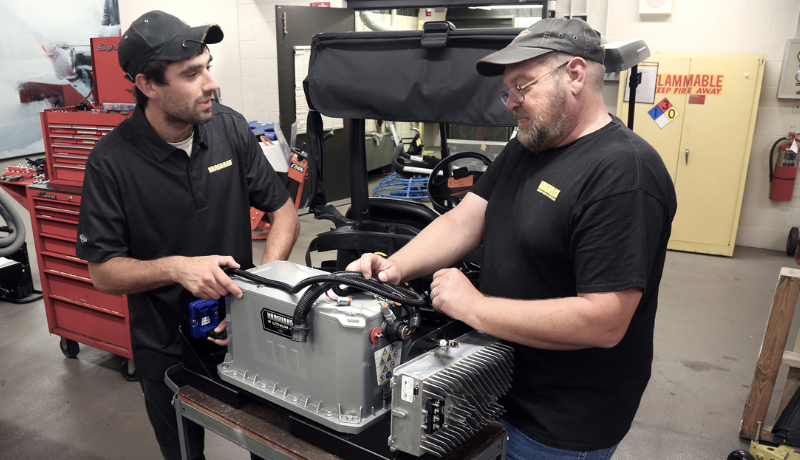
Vanguard’s Power Application Centres (PACs) and engineering teams partner with OEMs to collect real-world data and design data-driven, efficient electrification systems. In addition our Technology Partner Network provides even wider technical assistance.

Vanguard’s Unique Value Proposition

At Vanguard we are more than a component supplier — we are a technical integration partner:

  • With expertise in load profiling, battery chemistry, and power system design.
  • We help OEMs achieve the same (or better) performance with smaller, optimised batteries to reduce weight, cost, and footprint while maximising uptime and reliability.
  • We are backed by Briggs & Stratton's global support, advanced testing facilities, and proven field experience.
  • We offer a 8-year commercial warranty for our battery packs.

Battery-expertise-800x460

Electrify smarter, not harder — with Vanguard.

Endless options in every module.

No fancy web developer needed with CLEAN Pro.

You can get straigt down to business marketing your products and service. This template makes use of the Magic Module in a variety of well, MAGICAL, ways to help inspire you and show you all the amazing options available with this single module.

Technology Support

Technology-partners-icon-2-800x200

We offer OEMs a network of specialist partners to support technical development with our batteries.

Contact us

Contact-us-icon-black-800x200

Do you need further information on a specific product?
Are you looking for support to find the right power solution?